Police in Rockingham County, North Carolina, took a circuitous path to identify the killer of a couple who were shot to death in their home in Reidsville, NC. They utilized a “DNA dragnet,” kinship analysis, ancestry analysis, and DNA phenotyping to conclude that the killer was the brother-in-law of the daughter of slain couple. Had the initial DNA collection been slightly more complete, that effort alone would have sufficed.
The evidence that led to the man ultimately convicted of the double homicide were drops of the killer's blood:
Parabon Nanolabs,
The French Homicides, Jan. 4, 2017 [hereinafter Parabon]
In the early hours of 4 Feb 2012, Troy and LaDonna French were gunned down in their home in Reidsville, NC. The couple awoke to screams from their 19-year old daughter, Whitley, who had detected the presence of a male intruder in her second floor room. As they rushed from their downstairs bedroom to aid their daughter, the intruder attempted to quiet the girl with threats at knifepoint. Failing this, he released Whitley and raced down the stairs. After swapping his knife for the handgun in his pocket, he opened fire on the couple as they approached the stairwell. During his escape, the perpetrator left a few drops of his blood on the handrail, apparently the result of mishandling his knife. ...
Seth Augenstein,
Parabon’s DNA Phenotyping Had Crucial Role in North Carolina Double-Murder Arrest, Conviction, Forensic Mag., Jan. 5, 2017 [hereinafter Augenstein]
A couple were gunned down by an intruder in their North Carolina home in the early hours of Feb. 4, 2012. The teenaged daughter had seen the hooded gunman, when he had briefly held a knife to her throat, but she could apparently not describe him to cops. The attacker left several drops of blood on a handrail as he fled, apparently self-inflicted from his blade.
At a press conference, Sheriff Sam Page announced that "You can run, but you can’t hide from your DNA." Danielle Battaglia,
Blood on the Stairs, News & Record Greensboro.com, Apr. 14, 2016 [hereinafter Battaglia]. But efforts to follow the DNA seemed to lead nowhere.
Parabon
Running short of leads, investigators began collecting DNA samples from anyone thought to have been in or around the French home. "We swabbed a lot of people," says Captain Tammi Howell of the RCSO. "Early on, if there was a remote chance someone could have been connected to the crime, we asked for a swab." In the first 12 months following the crime, over 50 subjects consented to provide a DNA sample. None of the samples matched the perpetrator.
Augenstein
"We swabbed a lot of people," said Capt. Tammi Howell, of the Rockingham County Sheriff’s Office, who led the investigation. "Early on, if there was a remote chance someone could have been connected to the crime, we asked for a swab."
Those swabs produced no hits.
In particular, this screening of possible sources in the county eliminated "Whitley, her brother, and her boyfriend at the time, John Alvarez." Parabon. But police did not include Alvarez's father or his three brothers in their dragnet search, and when "[a]nalysts uploaded profiles of the blood drops and the skin fragments along with a sample from Whitley French into a database of known samples maintained by the FBI, [t]hey found no match." Battaglia. (According to
Forensic Magazine, "the killer was not in any of the public databases," but law enforcement DNA databases are not public.)
There is some confusion in the accounts of what happened next.
Parabon
The first break in the case came when familial DNA testing, performed at the University of North Texas, revealed the possibility that the perpetrator might be related to John Alvarez, Whitley's boyfriend. Because traditional DNA testing is limited in its ability to detect all but the closest relationships (e.g., parent-child), this report alone did not provide actionable information. Subsequently, scientists at the University of North Texas performed Y-chromosome STR analysis, which tests whether two male DNA samples share a common paternal lineage. This analysis, however, showed that the perpetrator did not share a Y-STR lineage with John Alvarez, seemingly eliminating John's father and brother as possible suspects.
Augenstein
Further analysis then indicated that the daughter’s boyfriend, John Alvarez (who had given a swab), could be related to the killer. But it was only a possible relationship, since the STR did not definitively say whether the killer and the boyfriend shared ancestry.
The partial DNA matching led to a Y-STR analysis. The short-tandem repeat on the Y chromosome shows paternal links between fathers, sons and brothers, and has produced huge breakthroughs in cases like the Los Angeles serial killer Lonnie Franklin, Jr., infamously dubbed the “Grim Sleeper.” But in the Sleeper and other cases used “familial searching,” or “FS,” a painstaking and somewhat controversial process of combing large state and national databases like CODIS to find partial DNA matches eventually leading to a suspect. FS was not used in the Rockingham County case, where they had a limited pool of suspects.
Battaglia
Investigators then decided to send the DNA samples out of state for what the warrant called “familial DNA testing,” a type of analysis that allows scientists to match DNA samples to a parent, child or sibling. According to warrants, the samples were sent to the Center for Human Identification at the University of North Texas in Denton. But they do not appear to have gone to that lab. And Rockingham County District Attorney Craig Blitzer said that although a lab did the familial DNA test, it was not North Texas. He declined to say where it was done.
The term "familial searching" has no well-established scientific meaning. As explained in David H. Kaye,
The Genealogy Detectives: A Constitutional Analysis of “Familial Searching”, 51 Am. Crim. L. Rev. 109 (2013), kinship testing of possible parents, children, and siblings can be done with the usual autosomal STR loci used for criminal forensic investigation. When this technique is applied to a database (local, state, or national), it sometimes reveals that the crime-scene DNA matches no one in the database but is a near miss to someone -- a near miss in such a way as to suggest the possibility that the source of the crime-scene sample is a brother, son, or parent of the nearly-matching individual represented in the database. In other words, "familial searching" is the process of trawling a database for possible matches to people outside of the database -- "outer-directed trawling," for short.
The Rockingham case evidently involved a conventional but fruitless database search ("inner-directed trawling") followed by testing -- in Texas or somewhere else -- to ascertain whether it was plausible that a close relative of the boyfriend was the source of the blood. Based on the autosomal STRs, this seemed to be the case. However, the laboratory threw a monkey wrench into the investigation when it reported that Y-STRs in the boyfriend's DNA did not match the blood DNA. Because Y-STRs are inherited (usually unchanged) from father to son, this additional finding seemed to exclude the untested father and brothers of the boyfriend.
But the social and familial understanding of a family tree does not always correspond to a biological family tree. It is not unheard of for genetic tests for parentage to reveal unexpected cases of illegitimate children. A man and child who believe that they are father and son may be mistaken. Genetic genealogists like to call the phenomenon of misattributed paternity a Non-Paternity Event, or NPE.
Thinking that the male members of the immediate Alvarez family had to be innocent, police were stymied. They turned to
Parabon Nanolabs in Reston, Virginia.
Parabon
[For $3,500, the lab,] starting with 30 ng of DNA, ... genotype[d] over 850,000 SNPs from the sample, with an overall call rate of 98.9% [and advised the police that the blood probably came from a man with] fair or very fair skin, brown or hazel eyes, dark hair, and little evidence of freckling, ... a wide facial structure and non-protruding nose and chin, and ... admixed ancestry, a roughly 50-50 combination of European and Latino ancestry consistent with that observed in individuals with one European and one Latino parent. ... "The Snapshot ancestry analysis and phenotype predictions suggested we should not eliminate José as a suspect, despite the Y-STR results," said Detective Marshall. "The likeness of the Snapshot composite with his driver's license photograph is quite striking."
Augenstein
From approximately 30 nanograms of DNA, the software genotyped approximately 850,000 single-nucleotide polymorphisms, or SNPs, at a call rate of 98.9 percent. In this case, the blood showed the killer to be someone with mixed ancestry – apparently someone with one European and one Latino parent. ... "The Snapshot ancestry analysis and phenotype predictions suggested we should not eliminate Jose (Jr.) as a suspect, despite the Y-STR results," said Det. Marcus Marshall, the lead investigator on the case. "The likeness of the Snapshot composite with his driver’s license photograph is quite striking."
At this time, Parabon proudly juxtaposes the "Snapshot Composite Profile and a photo of José Alvarez, Jr., taken at the time of his arrest"
on its website.(and shown below). One of the more intriguing (genetically associated?) similarities is the five o'clock shadow.
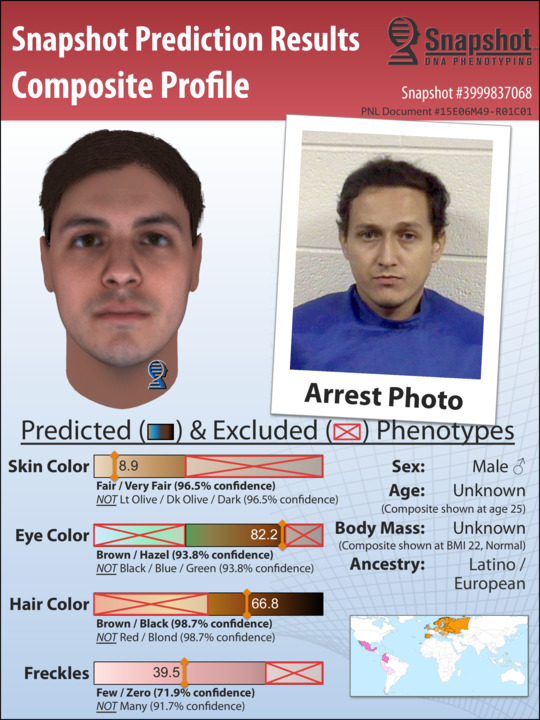
It also would be interesting to know how "confidence" in skin color and other phenotypes is computed. In any event, with this report, police finally obtained DNA samples by consent from the father, José Alvarez Sr., José Alvarez Jr., and Elaine Alvarez, the mother. Analysis indicated misattributed paternity -- and a conventional STR match of the DNA in the bloodstains. As a result,
Parabon
José Alvarez Jr. was arrested on 25 Aug 2015 on two counts of capital murder. He later pled guilty to both murders and on 8 Jul 2016 was sentenced to two consecutive life sentences without the possibility of parole.
Augenstein
Jose Alvarez, Jr., was ... arrested in August 2015 and charged with two counts of capital murder. He later pleaded guilty to killing the Frenches, and was sentenced to two consecutive life sentences without the possibility of parole in July 2016.
A final note on the twists and turns in the case is that John Alvarez's wedding to Whitley French "had been planned for months. Jose Alvarez Jr. served as a groomsman for his brother even as detectives were planning to arrest him on charges that he murdered his new sister-in-law’s parents." Battaglia.
Related posting
"We Can Predict Your Face" and Put It on a Billboard, Forensic Sci., Stat. & L., Nov. 28, 2016
