Showing posts with label Familial searching. Show all posts

Sunday, September 23, 2018

Is the NorCal Rapist Arrest Another Success Story for Forensic Genomic Genealogy?

On the morning of September 20, police arrested Roy Charles Waller, 58, of Benicia, California, for 10 rapes over a 15-year period starting in 1991. A Washington Post article described the crucial lead in the case as "what's called a familial DNA search." According to the Post,
    The arrest was reminiscent of that of Joseph James DeAngelo, who was arrested in April on the suspicion that he was the so-called “Golden State Killer,” who was wanted for raping dozens of women and killing at least 12 people in a bloody swath of crime that spanned decades in the state.
    Like DeAngelo, Waller was arrested after police searched the genealogy site GEDmatch for leads. In DeAngelo’s case, officials did what’s called a familial DNA search of GEDmatch, in which they sought to find someone who was closely genetically related to and worked backward to find a suspect. Familial DNA searching, particularly as it relates to government-run DNA databases, has come into wider use around the country, but it raises complicated questions about whether it means that the privacy rights of people are forfeited, in effect, by the decisions made by their relatives.
    It was not immediately clear if police did a familial search in Waller’s case or found his profile in GEDmatch.
In forensic genetics, "familial searching" normally refers to trawling a law-enforcement database of DNA profiles after failing to find a match between a profile in the database and a profile from a crime-scene sample at a mere 20 or so STRs (short tandem repeats of a short string of base pairs) in the genome of billions of base pairs. But a near miss to a profile in the database might be the result of kinship -- the database inhabitant does not match, but a very close relative outside the database does. A more precise description of such "familial searching" is outer-directed kinship trawling of law-enforcement databases (Kaye 2013).

The Post's suggestion that the NorCal Rapist may have been identified through "familial DNA searching" and the statement that "[f]amilial DNA searching, particularly as it relates to government-run DNA databases ... raises complicated questions about whether it means that the privacy rights of people are forfeited, in effect, by the decisions made by their relatives" is badly confused. The inhabitants, so to speak, of the law-enforcement databases, have not elected to be there. Their relatives, near or distant, have not chosen to enroll in the database. DNA profiles are in these databases because of a conviction or, sometimes, an arrest for certain crimes. The profiles are not useful for much of anything other than personal identification and kinship testing for close relatives (lineal and siblings).

The "genealogy site GEDmatch" is very different. It is populated by individuals who have elected to make their DNA searchable for kinship by other people who are looking for possible biological relatives. These trawls do not use the limited STR profiles developed for both inner- and outer-directed trawls of offender databases. They use the much more extensive set of SNPs (single-nucleotide polymorphisms) -- hundreds of  thousands of them -- that genetic testing companies such as 23-and-me provide to consumers who are curious about their traits and ancestry. Those data can be used to infer more attenuated kinship. Knowing that long, shared stretches of DNA in the crime-scene sample and the sample in a private (that is, nongovernmental) genealogy database such as GEDmatch could reflect a common ancestor several generations back enables genealogists using public information about families to walk up the family tree to a putative common ancestor and then down again to living relatives.

It is clear enough that California officials used the latter kind of kinship trawling in the publicly accessible genealogy database GEDmatch to find Mr. Waller. At a half-an-hour long press conference, Sacramento County  District Attorney Anne Marie Schubert refused to give direct answers to questions such as "Did a relative upload something?" and did you have to go through a lot of family members to get to him? However, she did state that "[t]he link was made through genetic genealogy through the use of GEDmatch." Eschewing details, she repeated "It's genetic genealogy, that's what I'll say." If Mr. Waller had put his own genome-wide scan on GEDmatch, why would Ms. Schubert add "a lot of kudos to the folks in our office ... that I call the experts in tree building"? The district attorney's desire not to say anything about specific family members reflects a commendable concern about unnecessarily divulging information about the family, but she could have been more transparent about the investigative procedure without revealing any particularly sensitive information on the family or any material that would interfere with the prosecution.

REFERENCES

Saturday, June 23, 2018

Trawling Genealogy Databases and the Fourth Amendment: Part I

Law-enforcement use of a DNA database created for genealogy enthusiasts helped discover the man believed to be the Golden State Killer. It also provoked an immediate outpouring of media reports of concerns about "genetic privacy." Now, essays from groups of bioethicists and lawyers have appeared in both the Annals of Internal Medicine [1] and Science [2]. Neither article gives a convincing and complete analysis of the legal issues—hardly surprising given the word limits for such policy forum essays—but both are useful as starting points for discussion.

I. The Misplaced “Abandonment” Theory

The Annals article, Is It Ethical to Use Genealogy Data to Solve Crimes? [1], assures us that the law provides “clarity.” The authors find this clarity in “the abandonment doctrine.” The following paragraph comprises their entire legal analysis:
The legal questions raised by genealogy searches are measurably simpler than the ethical concerns. In terms of the U.S. Constitution, a genealogy search triggered by DNA collected from a crime scene probably would not count as a “search” under the Fourth Amendment (4). Even assuming it would, the applicable legal theory—the “abandonment doctrine”—holds that a person has no “reasonable expectation of privacy” in abandoned materials. Courts have allowed law enforcement to test DNA “abandoned” in a range of settings (such as hair clippings and discarded cigarette butts). At genealogy Web sites, users voluntarily upload (that is, abandon) familial data into commercial databases. Whether they are aware that their data are subject to police collection is, legally, irrelevant (5). Notwithstanding the clarity of the law, it is questionable whether it is good social policy to consider the uploading of genealogic data the same as abandoning DNA in a public space.
These remarks confuse two very different questions. The first is whether a data-gathering method is a search within the meaning of the Fourth Amendment. The Amendment protects against “unreasonable searches and seizures” of “persons, houses, papers, and effects,” in large part by requiring police to acquire judicial warrants based on probable cause before undertaking a search or seizure. (Reliance on a properly issued warrant makes the search reasonable.)

But not all information collection is a search or seizure that triggers the Fourth Amendment demand for reasonableness. For example, a police officer who merely watches a shady character—or anyone else—walk down the street has not searched or seized anyone. If the officer snaps a photo of the person and compares it to photos of wanted criminals, there is still no search or seizure, for there has been no interference with the individual’s body, movements, or property. And if no search has occurred, there is no need to ask whether the officer’s decision to study the individual was reasonable in light of the facts known to the officer. The notion that what a person knowingly exposes to the general public cannot be the subject of a “search” is sometimes called the “public exposure doctrine.” It pertains to the threshold question of whether a search has occurred.

The “abandonment doctrine” also applies to this threshold question. It applies to property that a person has discarded or left behind. If the police see an individual throw away a syringe, they may collect it and then analyze it for the presence of heroin without obtaining a warrant—because they have not performed a search that affects any legitimate interest. By intentionally relinquishing the syringe, the individual has given up any property interest. He or she might not want it to become known that the syringe has traces of heroin in it, but if heroin possession is a criminal act, then the individual can hardly claim that the interest in keeping this fact secret is legitimate and hence protected by the Fourth Amendment. So the abandonment doctrine is another route to a conclusion that the police have conducted no search or seizure within the meaning of the Amendment.

The lower courts have almost always applied the abandonment doctrine to DNA molecules shed or deposited in both legal and illegal activities. But it is odd to maintain, as Is It Ethical? does, that abandonment makes a search reasonable because “a person has no ‘reasonable expectation of privacy’ in abandoned materials.” That mistakes the question of whether a search is justified for the question of whether the police conduct is a search. The “reasonable expectation” standard, introduced in Katz v. United States, 389 U.S. 347 (1967), is merely a way to show that police have engaged in a search; it is not a way to show that a search is reasonable.

This distinction may sound finicky. Functionally, what is the difference between (1) defining everything as a search, but then asking whether the investigation is reasonable because there is no reasonable expectation of privacy in the items searched, and (2) asking whether there is a search because there is no reasonable expectation of privacy in the first place? The major difference is that the first inquiry focuses solely on the information-gathering practice's invasion of individual interests: Does the practice implicate an interest that the Amendment protects? The second question is broader and different. It asks how gravely the practice infringes that interest and how much the practice serves government interests that would be frustrated by the need to secure a warrant based on probable cause.

The use of the term "abandonment" to reject the claim that there has been a search does not automatically justify the search. The opinions allowing the police to profile shed DNA and compare the identifying profile with a suspect's DNA (or with all the profiles in a law enforcement DNA database), all without a warrant, do not demonstrate that police can also trawl a database of DNA sequences to see who might be related to whom. Further analysis is required to determine the constitutionality of familial, or other-directed searching by the state in both law-enforcement [3] and private (i.e., non-governmental) databases such as GEDmatch and the more restrictive commercial ones.

With respect to the private databases, the state's argument lies not so much in abandonment as in public exposure. The very reason the individual puts DNA data on the database is to enable curious members of the public to inspect it. As such, the Fourth Amendment issue is whether police (without a warrant) can do what anyone else can—namely, trawl the database for a partial match indicative of a genetic relationship to the suspect whose DNA is associated with a crime. In many contexts—overflying private property to get a look at what is there, for example—the Supreme Court has reasoned that what is open to the public generally is open to the police as well. Indeed, the Court has even held that entrusting or conveying information to private parties defeats the claim of a reasonable expectation of privacy and hence the claim of a search that requires probable cause and a warrant. Exposure to a small slice of the public—even a banker or a telephone company—is enough let the police in without a showing of probable cause. (Disclosure of information to one’s lawyer may be protected by the attorney-client privilege but not the Fourth Amendment.)

In the past several years, however, some Justices have evinced discomfort with this “third-party doctrine.” Just yesterday, the Court held in Carpenter v. United States, No. 16–402, 2018 WL 3073916 (U.S. June 22, 2018), that certain data generated by a cell-phone service provider—the third party—is not outside the protective umbrella of the Fourth Amendment just because it has been given to or generated by a third party. The data in the case amounted to extended tracking of the past whereabouts of a person’s cellphone’s via the electronic tracks, so to speak, left at cell towers. That information, the majority reasoned, was so sensitive as to make its possession by the cellular phone service providers insufficient to defeat the claim of a reasonable expectation of privacy. A warrant was required.

The Science article correctly frames the pivotal Fourth Amendment issue as the scope of the third-party doctrine, but it leaves much unsaid. I will turn to the implications of this evolving doctrine for trawls of genealogy databases in a later installment.

REFERENCES
  1. Benjamin E. Berkman, Wynter K. Miller & Christine Grady, Is It Ethical to Use Genealogy Data to Solve Crimes?, Annals Internal Med., May 29, 2018, DOI: 10.7326/M18-1348.
  2. Natalie Ram, Christi J. Guerrini & Amy L. McGuire, Genealogy Databases and the Future of Criminal Investigation, 360 Science 1078-1079 (2018) DOI: 10.1126/science.aau1083
  3. David H. Kaye, The Genealogy Detectives: A Constitutional Analysis of “Familial Searching”, 51 Am. Crim. L. Rev. 109 (2013), https://ssrn.com/abstract=2043091
[Modified 29 Sept. 2018]

Monday, January 9, 2017

If You Are Going To Do a “DNA Dragnet,” Cast the Net Widely

Police in Rockingham County, North Carolina, took a circuitous path to identify the killer of a couple who were shot to death in their home in Reidsville, NC. They utilized a “DNA dragnet,” kinship analysis, ancestry analysis, and DNA phenotyping to conclude that the killer was the brother-in-law of the daughter of slain couple. Had the initial DNA collection been slightly more complete, that effort alone would have sufficed.

The evidence that led to the man ultimately convicted of the double homicide were drops of the killer's blood:
Parabon Nanolabs, The French Homicides, Jan. 4, 2017 [hereinafter Parabon]

In the early hours of 4 Feb 2012, Troy and LaDonna French were gunned down in their home in Reidsville, NC. The couple awoke to screams from their 19-year old daughter, Whitley, who had detected the presence of a male intruder in her second floor room. As they rushed from their downstairs bedroom to aid their daughter, the intruder attempted to quiet the girl with threats at knifepoint. Failing this, he released Whitley and raced down the stairs. After swapping his knife for the handgun in his pocket, he opened fire on the couple as they approached the stairwell. During his escape, the perpetrator left a few drops of his blood on the handrail, apparently the result of mishandling his knife. ...
Seth Augenstein, Parabon’s DNA Phenotyping Had Crucial Role in North Carolina Double-Murder Arrest, Conviction, Forensic Mag., Jan. 5, 2017 [hereinafter Augenstein]

A couple were gunned down by an intruder in their North Carolina home in the early hours of Feb. 4, 2012. The teenaged daughter had seen the hooded gunman, when he had briefly held a knife to her throat, but she could apparently not describe him to cops. The attacker left several drops of blood on a handrail as he fled, apparently self-inflicted from his blade.
At a press conference, Sheriff Sam Page announced that "You can run, but you can’t hide from your DNA." Danielle Battaglia, Blood on the Stairs, News & Record Greensboro.com, Apr. 14, 2016 [hereinafter Battaglia]. But efforts to follow the DNA seemed to lead nowhere.
Parabon
Running short of leads, investigators began collecting DNA samples from anyone thought to have been in or around the French home. "We swabbed a lot of people," says Captain Tammi Howell of the RCSO. "Early on, if there was a remote chance someone could have been connected to the crime, we asked for a swab." In the first 12 months following the crime, over 50 subjects consented to provide a DNA sample. None of the samples matched the perpetrator.
Augenstein
"We swabbed a lot of people," said Capt. Tammi Howell, of the Rockingham County Sheriff’s Office, who led the investigation. "Early on, if there was a remote chance someone could have been connected to the crime, we asked for a swab." Those swabs produced no hits.
In particular, this screening of possible sources in the county eliminated "Whitley, her brother, and her boyfriend at the time, John Alvarez." Parabon. But police did not include Alvarez's father or his three brothers in their dragnet search, and when "[a]nalysts uploaded profiles of the blood drops and the skin fragments along with a sample from Whitley French into a database of known samples maintained by the FBI, [t]hey found no match." Battaglia. (According to Forensic Magazine, "the killer was not in any of the public databases," but law enforcement DNA databases are not public.)

There is some confusion in the accounts of what happened next.
Parabon
The first break in the case came when familial DNA testing, performed at the University of North Texas, revealed the possibility that the perpetrator might be related to John Alvarez, Whitley's boyfriend. Because traditional DNA testing is limited in its ability to detect all but the closest relationships (e.g., parent-child), this report alone did not provide actionable information. Subsequently, scientists at the University of North Texas performed Y-chromosome STR analysis, which tests whether two male DNA samples share a common paternal lineage. This analysis, however, showed that the perpetrator did not share a Y-STR lineage with John Alvarez, seemingly eliminating John's father and brother as possible suspects.
Augenstein
Further analysis then indicated that the daughter’s boyfriend, John Alvarez (who had given a swab), could be related to the killer. But it was only a possible relationship, since the STR did not definitively say whether the killer and the boyfriend shared ancestry.
The partial DNA matching led to a Y-STR analysis. The short-tandem repeat on the Y chromosome shows paternal links between fathers, sons and brothers, and has produced huge breakthroughs in cases like the Los Angeles serial killer Lonnie Franklin, Jr., infamously dubbed the “Grim Sleeper.” But in the Sleeper and other cases used “familial searching,” or “FS,” a painstaking and somewhat controversial process of combing large state and national databases like CODIS to find partial DNA matches eventually leading to a suspect. FS was not used in the Rockingham County case, where they had a limited pool of suspects.
Battaglia
Investigators then decided to send the DNA samples out of state for what the warrant called “familial DNA testing,” a type of analysis that allows scientists to match DNA samples to a parent, child or sibling. According to warrants, the samples were sent to the Center for Human Identification at the University of North Texas in Denton. But they do not appear to have gone to that lab. And Rockingham County District Attorney Craig Blitzer said that although a lab did the familial DNA test, it was not North Texas. He declined to say where it was done.
The term "familial searching" has no well-established scientific meaning. As explained in David H. Kaye, The Genealogy Detectives: A Constitutional Analysis of “Familial Searching”, 51 Am. Crim. L. Rev. 109 (2013), kinship testing of possible parents, children, and siblings can be done with the usual autosomal STR loci used for criminal forensic investigation. When this technique is applied to a database (local, state, or national), it sometimes reveals that the crime-scene DNA matches no one in the database but is a near miss to someone -- a near miss in such a way as to suggest the possibility that the source of the crime-scene sample is a brother, son, or parent of the nearly-matching individual represented in the database. In other words, "familial searching" is the process of trawling a database for possible matches to people outside of the database -- "outer-directed trawling," for short.

The Rockingham case evidently involved a conventional but fruitless database search ("inner-directed trawling") followed by testing -- in Texas or somewhere else -- to ascertain whether it was plausible that a close relative of the boyfriend was the source of the blood. Based on the autosomal STRs, this seemed to be the case. However, the laboratory threw a monkey wrench into the investigation when it reported that Y-STRs in the boyfriend's DNA did not match the blood DNA. Because Y-STRs are inherited (usually unchanged) from father to son, this additional finding seemed to exclude the untested father and brothers of the boyfriend.

But the social and familial understanding of a family tree does not always correspond to a biological family tree. It is not unheard of for genetic tests for parentage to reveal unexpected cases of illegitimate children. A man and child who believe that they are father and son may be mistaken. Genetic genealogists like to call the phenomenon of misattributed paternity a Non-Paternity Event, or NPE.

Thinking that the male members of the immediate Alvarez family had to be innocent, police were stymied. They turned to Parabon Nanolabs in Reston, Virginia.
Parabon
[For $3,500, the lab,] starting with 30 ng of DNA, ... genotype[d] over 850,000 SNPs from the sample, with an overall call rate of 98.9% [and advised the police that the blood probably came from a man with] fair or very fair skin, brown or hazel eyes, dark hair, and little evidence of freckling, ... a wide facial structure and non-protruding nose and chin, and ... admixed ancestry, a roughly 50-50 combination of European and Latino ancestry consistent with that observed in individuals with one European and one Latino parent. ... "The Snapshot ancestry analysis and phenotype predictions suggested we should not eliminate José as a suspect, despite the Y-STR results," said Detective Marshall. "The likeness of the Snapshot composite with his driver's license photograph is quite striking."

Augenstein
From approximately 30 nanograms of DNA, the software genotyped approximately 850,000 single-nucleotide polymorphisms, or SNPs, at a call rate of 98.9 percent. In this case, the blood showed the killer to be someone with mixed ancestry – apparently someone with one European and one Latino parent. ... "The Snapshot ancestry analysis and phenotype predictions suggested we should not eliminate Jose (Jr.) as a suspect, despite the Y-STR results," said Det. Marcus Marshall, the lead investigator on the case. "The likeness of the Snapshot composite with his driver’s license photograph is quite striking."
At this time, Parabon proudly juxtaposes the "Snapshot Composite Profile and a photo of José Alvarez, Jr., taken at the time of his arrest" on its website.(and shown below). One of the more intriguing (genetically associated?) similarities is the five o'clock shadow.
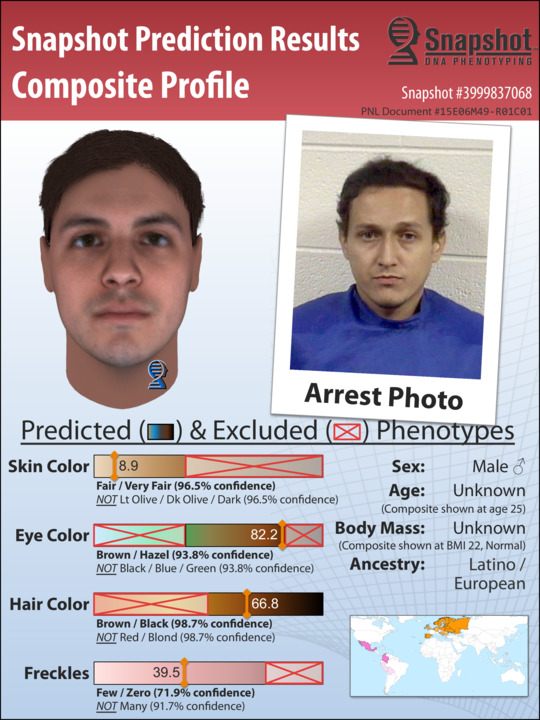
Snapshot™ Composite Profile for Case #3999837068, Rockingham County, NC Sheriff's Office

It also would be interesting to know how "confidence" in skin color and other phenotypes is computed. In any event, with this report, police finally obtained DNA samples by consent from the father, José Alvarez Sr., José Alvarez Jr., and Elaine Alvarez, the mother. Analysis indicated misattributed paternity -- and a conventional STR match of the DNA in the bloodstains. As a result,
Parabon
José Alvarez Jr. was arrested on 25 Aug 2015 on two counts of capital murder. He later pled guilty to both murders and on 8 Jul 2016 was sentenced to two consecutive life sentences without the possibility of parole.
Augenstein
Jose Alvarez, Jr., was ... arrested in August 2015 and charged with two counts of capital murder. He later pleaded guilty to killing the Frenches, and was sentenced to two consecutive life sentences without the possibility of parole in July 2016.
A final note on the twists and turns in the case is that John Alvarez's wedding to Whitley French "had been planned for months. Jose Alvarez Jr. served as a groomsman for his brother even as detectives were planning to arrest him on charges that he murdered his new sister-in-law’s parents." Battaglia.

Related posting

"We Can Predict Your Face" and Put It on a Billboard, Forensic Sci., Stat. & L., Nov. 28, 2016

Monday, September 12, 2016

US Dep't of Justice to discourage expressions of "reasonable scientific certainty"

At this afternoon's 11th meeting of the National Commission on Forensic Science, Dr. Victor Weedn, "the Senior Forensic Advisor to the Deputy Attorney General," informed the Commission of the Department of Justice's responses to its recent recommendations. He explained that the Department is "adopting the core" of the recommendations seeking to discourage the use of the phrase "reasonable scientific certainty" and variants on it in reports and testimony. In particular, Department forensic labs will adopt policies and procedures to ensure that such terms are not used, and Department prosecutors will abstain from posing questions with these terms to witnesses (unless required to do so by judges). Commission member, theoretical physicist James Gates, complimented the Department for dealing with these words that "make scientists cringe."

Sunday, January 4, 2015

Buza Reloaded: California Balancing

This is the fourth installment on Buza II, the opinion of the California court of appeal that invalidates the state's DNA-on-arrest law. It discusses the part of the opinion that argues that the balance the U.S. Supreme Court struck in Maryland v. King is either flatly wrong or wrong for California. In giving substantial weight to concerns over "familial searching" and the information content of DNA samples, the opinion assumes that it is appropriate to strike down a law that is constitutionally reasonable as currently implemented because future developments might make it unreasonable as then implemented. This premise is highly contestable.

Formally, the conclusion that California's DNA-BC (Before Conviction) law is unreasonable under the Fourth Amendment as it appears in the California Constitution does not imply that it is unreasonable under the Fourth Amendment as it exists in the U.S. Constitution. California is a sovereign state of the Union, and its courts can read different meanings into the words of its constitution. But many of the reasons the Buza II opinion gives for its conclusion—if correct—also apply to nearly all of the 25 or so DNA-BC laws on the books, and the opinion itself indicates that, in large part, the divergence between Buza II and King emanates from the California judges’ outright disagreement with the Supreme Court's balancing in King.

To begin with, the California judges complain that King “unjustifiably dismissed concerns about the extent of the personal information contained in DNA samples by limiting ... attention to the profile used in DNA databanks, as currently restricted by statutes and scientific capability.” One might expect that this observation immediately would be followed by the undeniable fact that the entirety of a person’s genome contains some medically significant information that would not otherwise be known, such as predispositions to certain diseases. Testing for these alleles (or for markers for them) would pose significant privacy issues (which is why such testing generally is prohibited without the individual’s consent).

But the opinion veers off into a superficial discussion about the CODIS profile itself. The problem, according to Buza II, is that the profile can be used not merely to identify an individual whose DNA is taken when he is arrested, but also sometimes can be used to identify a first-degree relative as a likely source (when the arrestee’s DNA is a close mismatch to the crime-scene sample). This “familial searching,” as the court calls it, is a “factor not relevant to identity,” and therefore “present[s] additional privacy concerns.”

The second part of this statement is true enough. Like a perfect match, a close mismatch is relevant to the identity of the DNA source, but it also reveals that the arrestee could be genetically related to the source of the crime-scene DNA. 1/ Consider the “Grim Sleeper” case of serial rapes and murders in the Los Angeles area, with years of apparent inactivity between some of the attacks. Trawls of the database proved fruitless—until Christopher Franklin was convicted of a felony. His DNA profile did not match the Grim Sleeper’s, but it lined up with it in a manner that would be expected if the two were father and son. This led investigators to Christopher’s father, Lonnie Franklin, Jr. In this way, Lonnie emerged as a suspect only because of his son’s conviction. (His DNA profile was not in the database because his arrests had occurred before California had a database.) Now he stands accused of ten murders.

People v. Franklin reveals an important fact about kinship trawling. In Franklin, it is difficult to discern the slightest “additional privacy concerns.” That Lonnie was Christopher’s father was a publicly known fact, not a private secret. Furthermore, Lonnie can hardly claim to have a legitimate Fourth Amendment interest in keeping secret the fact that it was his DNA that was found on or around murdered women. 

Of course, there could be other cases in which the familial relationship between the database inhabitant and the culprit was not known to one or both of the genetically related individuals. In such situations, the claim to a right to keep the genetic relationship secret is more plausible. But the existence of possible cases of this kind does not demonstrate that the occasional legitimate privacy interests that might be affected by the rare, "other-directed" trawls (that look for people outside of the database) outweigh those of the government.

In particular, for Mark Buza and his relatives to have an additional privacy interest compromised by the arresteee database, at least two conditions would have to be fulfilled. First, California would have to initiate other-directed trawls of its arrestee database. It has never done so, and it cannot do so under the policy its Department of Justice has adopted for such database trawling. This policy confines the other-directed trawling to convicted-offender databases. Second, Mark Buza would have to have publicly unknown first-degree relatives whose DNA profile would be close enough to Mark’s to implicate them in other crimes via a kinship match to Mark’s profile.

On its face, the first condition suggests that the parts of the opinion discussing “familial searching” are inapposite. Why strike down a law because of what could be but is not? Nonetheless, the Buza court’s sensitivity to the possibility of a change in the state’s DNA-BC practice might be seen as prescient rather than premature. From the outset, an argument against DNA databases has been mission creep. Once the database is established, the state will be tempted to use it for additional and more insidious purposes. To guard against this outcome, the argument goes, society should bind itself to the mast in anticipation of an irresistible siren song.

There are situations in which this self-disabling strategy is advisable. Indeed, much of the Bill of Rights constrains the majority from doing what seems expedient or appealing in the heat of the political moment. But it is not so clear that a handful of judges should block the democratic decision to allow DNA-BC to be used in acceptable ways that advance law enforcement on the ground that the system might be administered in unacceptable ways at some future time. If and when a jurisdiction combines other-directed trawling and DNA-BC, courts can consider whether that type of trawling is so serious an invasion of privacy as to render it unconstitutional. Cf. United States v. Knotts, 460 U.S. 276 (1983) ("if such dragnet type law enforcement practices as respondent envisions should eventually occur, there will be time enough then to determine whether different constitutional principles may be applicable."). Using the mere possibility of a correctable change in the allowed uses of the DNA data to strike down the collection and otherwise acceptable uses of the data seems Draconian.

Moreover, relying on future familial searching as a ground for striking down the system as currently implemented is inconsistent with Buza II’s effort to distinguish the Maryland practice. Presiding Justice Kline emphasized the existence of a Maryland statute banning familial searching. But as Chief Judge Alex Kozinski of the U.S. Court of Appeals for the Ninth Judicial Circuit tartly observed in oral argument in Haskell v. Harris (a separate case challenging California DNA-BC law), statutes can be changed too. The logic of Buza II—that databases that are constitutionally reasonable (as currently implemented) but might become unreasonable (as implemented in the future) are constitutionally unreasonable ab initio—would render the Maryland law on DNA-BC unconstitutional.

Despite these problems, Buza II applies the nip-it-in-the-bud reasoning not only to DNA profiles but also to samples. Displaying little knowledge of behavioral genetics, the court invokes “the pedophile gene” and “the violence gene” that, it imagines, might well be discovered some day. It predicts that “surely law enforcement will seek to mine genetic information for that ‘identification purpose.’” 
But there is no good reason to believe that the word “identification” as used in DNA-BC laws would permit predictive genetic testing for these behaviors, and the court makes no attempt to explain why such testing could not be condemned as constitutionally unreasonable if and when the time arises.

My criticism of the court of appeal's reliance on dystopic visions of the future is not based on naive faith in the goodness of police and law enforcement laboratories. Courts need not—and should not—trust law enforcement to exercise perfect self-restraint in investigative methods that easily can be abused. Before approving a DNA database system, they should satisfy themselves that sufficient safeguards against predictable abuses are in place. But if such protections are present, courts should not invalidate a system because the safeguards might be removed or might cease to be effective in the future. In this case, might does not make the decision right.

Note
  1. Confusingly, the court presents this fact as if it "disproves the King majority’s assumption that 'the CODIS loci come from noncoding parts of the DNA that do not reveal the genetic traits of the arrestee.'" Some noncoding DNA does affect visible traits of an arrestee, but the CODIS loci, as far as current science can tell, do not reveal much about any phenotypes. Because all DNA sequences are inherited, however, including those that King (also confusingly) calls "junk," the ones that vary across individuals, can be used in kinship analysis. In fact, the sequences that do give rise to individual traits often are the best for this purpose because they tend to be extremely variable within populations.
References
Closely related postings

Tuesday, July 29, 2014

A Long Shot Pays Off in Long Island

A family member shouted “we love you” as police took John Bittrolff back to jail. A court in Long Island had just ordered him held without bail on charges of murdering two women over 20 years ago. “Some arrests take a few hours, some days; some take 20 years,” Suffolk County Police Commissioner Edward Webber told reporters.

If police have the killer, it is a success for “familial searching” — the practice of trawling a database for near misses that are especially likely to arise when the source of traces of DNA recovered from crime scenes or victims are very close relatives of one of the “inhabitants” of the database — convicted offenders or, increasingly, arrestees.

Mr. Bittrolff’s DNA profile was not in the New York database. (He had been arrested, but not convicted, for assault in 1993.) However, last year, his brother, Timothy, had been required to give a sample of DNA after a conviction for violating protective orders. DNA from semen found inside the bodies of both women pointed to a brother of Timothy as the source of that semen. But the two victims were said to have been prostitutes, and Mr. Bittrolff’s counsel have been quick to note that "having sex does not mean killing."

In addition to increasing the modest number of possibly successful “outer directed” database trawls, the case is interesting for some procedural twists involving the acquisition of DNA samples. As in the California “grim sleeper” case, police did not initially seek a court order for a sample of their suspect’s DNA to verify that he was indeed associated with the victim’s bodies. Instead, detectives helped themselves to paper bags of garbage left in front of John Bittrolff's house. Among the plastic cups, drink bottles, toothpicks, straws, crawfish heads, cotton swabs, and bandages, they found DNA from his sons, his brother, and his wife (who they trailed until they collected a cigarette butt that she tossed from the window of her truck while driving to work). And, on one paper cup, they found a DNA profile that matched the semen.

But the police were not satisfied. They arrested wiped DNA from a cup of water John Bittrolff drank after his arrest. And even that was not enough. The assistant district attorney (ADA) then applied for a court order to force the twice-DNA-matched suspect to submit to DNA sampling.

Defense lawyers objected that a third sample from Mr. Bittrolff was manifestly unnecessary. The ADA’s response was that prosecutors are entitled to a "judicially approved" DNA sample to present to a grand jury. The court issued the order, and that is where the case stands as of now.

I cannot say that I understand the prosecutor’s reasoning. Unless New York grand jury procedure is very different from the norm, a prosecutor can introduce all manner of evidence without judicial approval. Grand jurors can even rely on unconstitutionally seized evidence without offending the Fourth Amendment.

Was the ADA looking ahead to the trial? Would he want to avoid having to explain the artifices — the “familial searching,” the personal surveillance of family members, and the garbage pull — that the police used to acquire the earlier samples? He might be able to excise all that from the case with a “judicially approved” sample. In any event, the People will present their evidence to the grand jury on Thursday.

References

The information on the case comes from the following media reports:
I have taken the liberty of using some words in these articles without quotation marks. For a detailed article on the nature and constitutionality of outer-directed DNA database trawling, see David H. Kaye, The Genealogy Detectives: A Constitutional Analysis of “Familial Searching”, 51 Am. Crim. L. Rev. 109 (2013)

Related Blogs

Saturday, March 15, 2014

A "Ridiculous" Fourth Amendment Argument in the Grim Sleeper Case?

On January 7, Los Angeles Superior Court Judge Kathleen Kennedy dismissed as "specious and ridiculous" one argument from the alleged "Grim Sleeper" serial killer Lonnie Franklin Jr. [1] According to Mr. Franklin's lawyers, the police violated his Fourth Amendment right to be free from unreasonable searches and seizures when they surreptitiously acquired and analyzed DNA that he left on his plate and utensils at a restaurant.

This is not the first notorious case in which Judge Kennedy has participated. In the prosecution of O.J. Simpson, when she was a municipal judge, she initially limited investigators to 10 hairs from Mr. Simpson's head for microscopic comparisons to hairs found in a blue knit cap lying near the bodies of Nicole Brown Simpson and Ronald Goldman. That "surreal" ruling reflected a lack of understanding of hair comparison protocols. [2, p. 230] However, the Grim Sleeper ruling is more mainstream. No court has treated collecting shed or inadvertently abandoned DNA as a search [3, p. 454]

Apparently, investigators did not want to alert Mr. Franklin that he was suspected of the long series of rapes and murders attributed to the Grim Sleeper. They had a police officer pose as a busboy at John's Incredible Pizza, where Franklin was attending a birthday party. Franklin argued that the officer-busboy cleared his plates — first pizza and then chocolate cake — before he had finished eating. and that this poor service made the collection unconstitutional.

One might not think much would turn on how close Franklin was to completing his repast. From time to time, I have had to tell an eager waiter reaching for my plate to wait -- I am not yet done. If a customer does not speak up, how can he be said to have a protected property interest in the plate, an interest that might trigger Fourth Amendment protection under United States v. Jones, 132 S.Ct. 945 (2012)? Moreover, if a failure to allow the restaurant patron time to eat all he wants is the source of the Fourth Amendment violation, the inevitable discovery exception to the warrant requirement could render the matter academic.

However, Franklin also claimed that he had a reasonable expectation that his plates would be thrown into a pile with others, making his DNA unavailable for testing. This is precisely the argument that the Supreme Court rejected in a questionable opinion in California v. Greenwood, 486 U.S. 35 (1988). In that case, police acquired sealed, plastic bags of trash that their suspect placed on the curb for municipal pickup. Greenwood argued that he expected that the bags would be mixed up with the other garbage in the neighborhood, preserving his privacy interest in the contents of his bags. But the majority of the Court deemed this expectation unreasonable because marauding dogs or curious people might go through the bags before the garbage truck arrived.

Even if that reasoning is convincing, however, the burden on the diner to take other steps to protect his DNA from inspection seems greater than that which Greenwood imposes on people to dispose of some parts of their trash privately. Judge Kennedy reportedly reasoned that "If [Franklin] were really concerned about such things, he would not eat or he would take his trash with him." [1] Is that the kind of world we want to have — one in which people who wish to keep their DNA to themselves must bring their own silverware, plates, and trash bags to restaurants or stay at home for all meals?

Thus, I think that the Fourth Amendment status of police collection of certain forms of shed or discarded DNA is a closer question that the caselaw suggests. There is a plausible argument that at least some surreptitious DNA collection from suspects amounts to a "search." Accepting this argument would not necessarily make this mode of DNA collection and analysis impermissible, for not all searches are unreasonable. But it would require more analysis of the individual and state interests at stake.

References
  1. Paresh Dave, Grim Sleeper: Judge Allows DNA Evidence Gathered at Restaurant, Los Angeles Times, Jan. 7, 2014
  2. David H. Kaye, The Double Helix and the Law of Evidence (2010)
  3. Albert E. Scherr, Genetic Privacy and the Fourth Amendment: Unregulated Surreptitious DNA Harvesting, 47 Ga. L. Rev. 445 (2013)
Related postings
  • MDNA, Forensic Science, Statistics, and the Law, Mar. 15, 2014
Key words: Abandoned DNA, Fourth Amendment, Surreptitious DNA collection, Greenwood, Franklin, Grim Sleeper, Kennedy, Los Angeles

Monday, December 19, 2011

Finegan's Wake: A Partial DNA Match in Rhode Island

A Rhode Island newspaper reports that "[t]he Cranston Police Department has arrested 49-year-old David Finegan, of no permanent address, for the burglary and sexual assault of an 81-year-old woman." [1] Police "collected [DNA] at the crime scene on May 2." On June 10, the Rhode Island Department of Health reported that it had a DNA profile from the crime with which to query an offender database. The Rhode Island laboratory did not use software designed for kinship searching, but on July 8, the department advised detectives that it had found a partial DNA match to a female inmate.

The article does not speculate on why it took a month to complete a routine computer search and report the results.Was it because of legal concerns? Was the partial match trawl intentional, or was the discovery inadvertent? Whichever it was, the detectives turned their attention to five male siblings. They discovered that one of them, David Finegan, was "in close proximity . . . on the night of the incident."

Why this roundabout method of identifying Finegan? He was on parole in July. Was the underlying offense not one that triggered entry into the DNA database? Was there a backlog in entering offender profiles into the database? Whatever the explanation, Finegan had the misfortune of being picked up on July 14 on a parole violation and held for the weekend. Detectives quickly obtained a search warrant and took a sample of DNA from him before he made bail and dropped out of sight. A week later, they learned that it matched the crime-scene DNA.

Pursuing an anonymous tip, police found and arrested Finegan in Providence. He "is being charged with burglary and first-degree sexual assault." Interestingly, he has an arrest record (including domestic assault, felony DWI, resisting arrest and other assaults) dating back to 1991. A bill that would expand the state database to include arrestees is before House and Senate committees in Rhode Island.

Reference

1. Joe Kernan, Arrest Made in Rape of Elderly Woman, Cranston Herald, Dec. 19, 2011

Acknowledgment

Thanks to Frederick Bieber for informing me of the Cranston Herald article.

Cross-posted from The Double Helix Law Blog

Sunday, November 27, 2011

Legislation to Implement Kinship Matching in Criminal DNA Databases

A few years ago, “Jeffrey Rosen, a constitutional law professor at George Washington University, warned: ‘I can guarantee if familial searching proceeds, it will create a political firestorm.’” (1) But familial searching, as it is tendentiously called, prompted no huge political protests when California, Colorado, New York, and Virginia adopted it administratively. Now, legislative initiatives to implement it in various states (2, 3) and federally (4) have begun. However, the proposed legislation is timid, usually authorizing the practice only in murder and sexual assault cases and only after traditional investigative methods have failed.

References

1. Maura Dolan & Jason Felch, California Takes Lead on DNA Crime-fighting Technique: The State Will Search its Database for Relatives of Unidentified Suspects in Hopes of Developing Leads, Los Angeles Times, Apr. 26, 2008

2. Mike Cook, DNA — It’s All in the Family, Minnesota House of Representatives Session Weekly: News from the House, Apr. 8, 2011

3. Mark Scolforo, DNA Proposal Has Foes: Pa. Bill to Expand its Collection Opposed by the ACLU, Phil. Inquirer, Oct. 2, 2011

4. Press Release, Schiff's Familial DNA Language Passes as Part of Conference Report, Nov. 21, 2011

Cross-posted from The Double Helix Law Blog

Tuesday, October 4, 2011

An Odd Set of Odds in Kinship Matching with DNA Databases

The 22d International Symposium on the Future of Human Identification began yesterday with a set of workshops. One was on "familial searching." The phrase refers to trawling the profiles in a DNA database for certain types of partial matches to a DNA profile from a crime-scene sample.

Partial matches that are useful in generating investigative leads to family members arise much more often when a particular kind of relative (say, a full sibling) is the source of the crime-scene sample than when an individual who is not closely related to the database inhabitant is the source. The ratio of the probability of the partial match under the former condition (a given genetic relationship) to the latter (unrelated individuals) is a likelihood ratio (LR). The LR (or, technically, its logarithm) for siblingship expresses the weight of the evidence in favor of the hypothesis that the source is full sibling as opposed to an unrelated individual.

After explaining the this idea, the first speaker presented the following formula:
"Odds" = LRautosomal x LRY-STR x 1/N         (1)
She attributed this formula to the California state DNA laboratory that does familial searching in that state. In this equation, N is the size of the database, LRautosomal is the likelihood ratio for the partial match at a set of autosomal STR loci, and LRY-STR is the likelihood ratio for the matching Y-STR haplotype.

She described this as a Bayesian computation that could lead to statements in court such as "there is a 98% probability" that the person whose DNA was found at the crime scene is a brother of Joe Smith, a convicted offender whose DNA profile is in a DNA database.

There are three interesting things to note about these suggestions. To begin with, it is not clear why such a statement would be introduced in a trial. By the time the suspect has become a defendant, a new sample of his DNA should have been tested to establish a full match to the crime-scene sample. At that point, why would the judge or jury care whether defendant is related to a database inhabitant. The relevance of the DNA evidence lies in the full match to the crime-scene sample, and the jury need not consider whether the defendant is a relative of someone not involved in the alleged crime. (One might ask whether the trawl through the database somehow degrades the probative value of the full match, but, if anything, it increases it. [1])

The issue could arise, however, if police were to seek a court order or search warrant to collect a DNA sample from the suspect. At that point, they would need to describe the significance of the partial match to the convicted offender.

This possibility brings us to the second noteworthy point about equation (1). The "odds" (or the corresponding probability) are not the way to present the weight of the partial match. Consider the prior probability of a match in a small database, say, of size N=2. Prior to considering the partial match, why would one think that the probability of a database inhabitant being the sibling of the criminal who resides outside the database is 1/N = 1/2? It is quite improbable that the database of two people includes a relative of every criminal who leaves DNA at a crime-scene. The a priori probability for a small database must be closer to 0 than 1/N.

That the prior probability is less than 1/N is a general result. The only exception occurs when it is absolutely certain that a sibling of the perpetrator is in the database. On that assumption, prior odds of 1 to N-1 are not unreasonable. But that assumption is entirely artificial, and to advise a magistrate that the posterior odds have the value computed according to (1) would be to overstate the implications of the partial match.

The third thing to note about dividing by N is that it accomplishes nothing in producing a viable list of partially matching profiles in a DNA database trawl. The straightforward approach is to produce a short list of candidates in the database whose first-degree relatives might be the source of the crime-scene sample. The minimum value of LRautosomal x LRY-STR should be large enough to keep the two conditional error probabilities (including a candidate when there is no relationship, and not including a candidate when there is a relationship) small. This threshold value does not depend on N. (A later speaker made this observation.)

Equation (1), it seems, is useless. Instead, the magistrate should be told the value of the LR and how often such large LRs would occur when a crime-scene sample comes from a relative versus how often it would occur when it comes from an related person.

Reference

1. David H. Kaye, 2009, Rounding Up the Usual Suspects: A Legal and Logical Analysis of DNA Database Trawls, North Carolina Law Review, 87(2), 425-503.